Since the establishment of Yichao in 2013, I have consulted with thousands of procurement managers and hardware engineers across the globe. One of the most recurring debates during the project quoting phase always centers around material selection. The dilemma is universal: how do you achieve meaningful PCB Cost Optimization without compromising the lifespan and safety of the final product? The answer often lies in understanding the critical differences between standard and advanced laminates.
In the realm of electronic manufacturing, specifying the correct Tg Glass Transition Temperature for your bare boards is a make-or-break decision. This guide is designed to provide B2B buyers with a clear, authoritative framework for navigating the choice between Standard vs High Tg PCB materials, ensuring you invest your budget exactly where it matters most.
1. Demystifying the Tg Value in Circuit Boards
Before making a purchasing decision, it is essential to understand the physics behind the specifications. “Tg” stands for Glass Transition Temperature. It is the specific temperature threshold at which the base substrate (usually FR-4 epoxy resin) shifts from a rigid, glassy state to a softened, rubbery state.
It is crucial to note that hitting the Tg limit does not mean the board will instantly melt or burn. However, once the temperature exceeds this threshold, the material’s mechanical and electrical properties degrade rapidly. The board will experience significant dimensional expansion, particularly in the Z-axis. This expansion can crack plated through-holes (PTH), tear internal copper traces, and lead to catastrophic open circuits. Therefore, choosing the right Tg is the foundation of High-Reliability Circuit Board Materials.
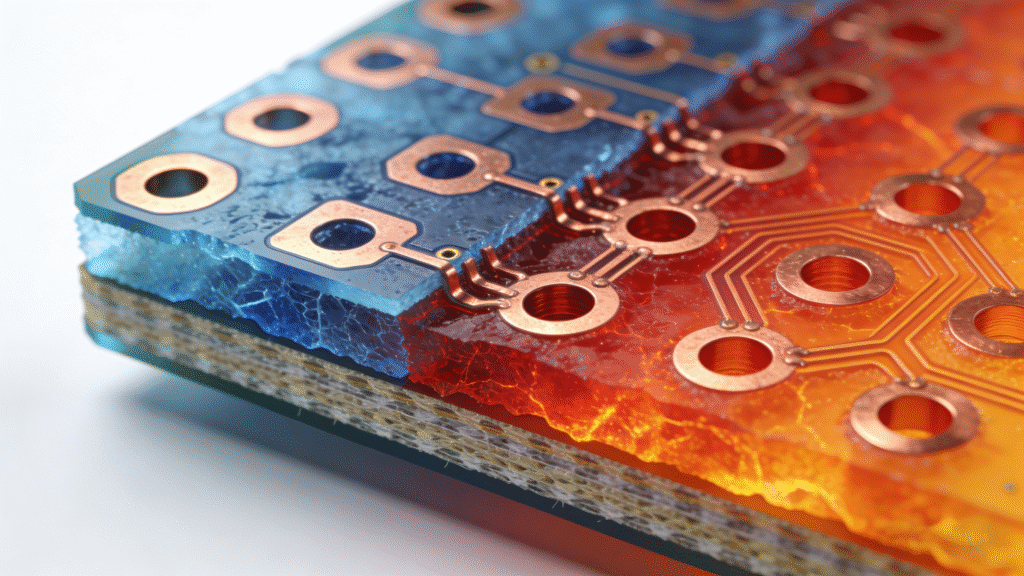
2. Standard vs High Tg PCB: The Direct Comparison
To make informed procurement choices, buyers must weigh the operational environment against the material capabilities. Here is how they stack up:
- Standard Tg (Typically 130°C – 140°C): This is the industry workhorse. It is highly cost-effective and perfectly suited for consumer electronics, simple communication devices, and applications operating in stable, room-temperature environments. If your product does not face extreme thermal cycling or prolonged high heat, standard Tg offers excellent value.
- Medium Tg (Typically 150°C – 160°C): A middle-ground option providing a slight buffer for moderately demanding environments without the premium price tag of top-tier materials.
- High Tg (Typically 170°C and above): This category is non-negotiable for harsh environments. Boards with a Tg of 170°C or higher exhibit superior heat resistance, lower moisture absorption, and excellent chemical resistance. They maintain structural integrity during multiple high-temperature RoHS-compliant lead-free soldering cycles.
3. When is High Tg PCB Manufacturing Mandatory?
While standard materials save money upfront, under-specifying your substrate will lead to massive field failure costs. As an industry veteran, I strongly advise transitioning to High Tg PCB Manufacturing under the following conditions:
High-Density Interconnect (HDI) and Multilayer Boards: If your design utilizes blind and buried vias, or scales up to 10, 20, or even 64 layers, the internal stress during pressing and soldering is immense. High Tg materials prevent delamination in these complex structures.
Automotive and Industrial Control: Environments involving engines, heavy machinery, or outdoor telecom infrastructure endure severe thermal shocks. At Yichao, aligning with our IATF16949 certification, we consistently recommend High Tg for automotive applications.
Heavy Copper Applications: Power supplies and servers utilizing thick copper (2oz, 3oz, or more) generate significant intrinsic heat. A high Tg substrate is required to dissipate this heat without warping the board.
4. Strategies for PCB Cost Optimization
Smart procurement is about maximizing ROI. Here is how you can achieve true PCB Cost Optimization while working with advanced materials:
First, evaluate your actual operating environment. Do not over-engineer a simple consumer gadget with a 180°C Tg material if it will never exceed 60°C in its lifetime. Second, leverage your manufacturer’s supply chain. At Yichao, our massive production scale allows us to stock premium High-Reliability Circuit Board Materials from top brands like Shengyi, Rogers, and Taconic at highly competitive rates.
Finally, consolidate your supply chain. Utilizing a one-stop solution for bare board manufacturing, component sourcing, and SMT assembly drastically reduces shipping overhead, communication delays, and scrap rates caused by multi-vendor handoffs.
5. Why Partner with Yichao for Your Material Needs?
Delivering high-quality electronic products requires a manufacturing partner capable of executing your precise material specifications. Since 2013, Yichao has evolved into a “specialized, refined, and innovative” enterprise. We support up to 64 layers and handle complex processes like HDI, thick copper, and metal-edged boards with ease.
Our commitment to a 99.8% product pass rate is supported by strict quality control, including internationally advanced six-axis drilling machines, AOI testing, and X-Ray inspection. Furthermore, our digital smart factory model enables unparalleled speed: offering a 1-minute online ordering system and fast shipping in as little as 12 hours. We empower over 1 million users globally to build better, more reliable products faster than ever before.
Final Thoughts
The choice between standard and high Tg materials is a balancing act between initial expenditure and long-term reliability. By accurately assessing your product’s thermal demands and partnering with an experienced, technologically advanced manufacturer, you can achieve the perfect equilibrium. Don’t let material failure compromise your brand’s reputation—specify with confidence.