
However, as an industry veteran consulting with global engineering teams, I frequently encounter a major procurement roadblock: premium high-frequency materials are expensive. How do B2B buyers and engineers achieve superior RF performance without destroying their project budget? The secret lies in strategic PCB Material Selection—specifically, understanding when to utilize a pure Rogers structure versus an advanced hybrid stackup.
In the rapidly evolving fields of 5G communications, automotive radar, and aerospace technology, signal integrity is paramount. As operating frequencies push well into the gigahertz (GHz) range, standard FR-4 materials simply cannot keep up, suffering from severe signal loss and unstable dielectric constants. This is where advanced Rogers PCB Manufacturing becomes essential.
1. The Demand for the Rogers High Frequency Board
Before diving into manufacturing structures, we must understand why a Rogers High Frequency Board is the gold standard for microwave applications. Materials from the Rogers Corporation (such as the RO4000 or RO3000 series) are engineered with exceptionally low Dielectric Constant (Dk) and low Dissipation Factor (Df). This means electrical signals travel faster, with minimal distortion and almost zero heat loss.
For applications like AI hardware sensors or medical imaging equipment, this level of precision is non-negotiable. However, processing these specialized PTFE or ceramic-filled hydrocarbon laminates requires a manufacturing facility with highly specialized lamination and drilling capabilities.
2. The Pure-Pressing Structure: Uncompromising Performance
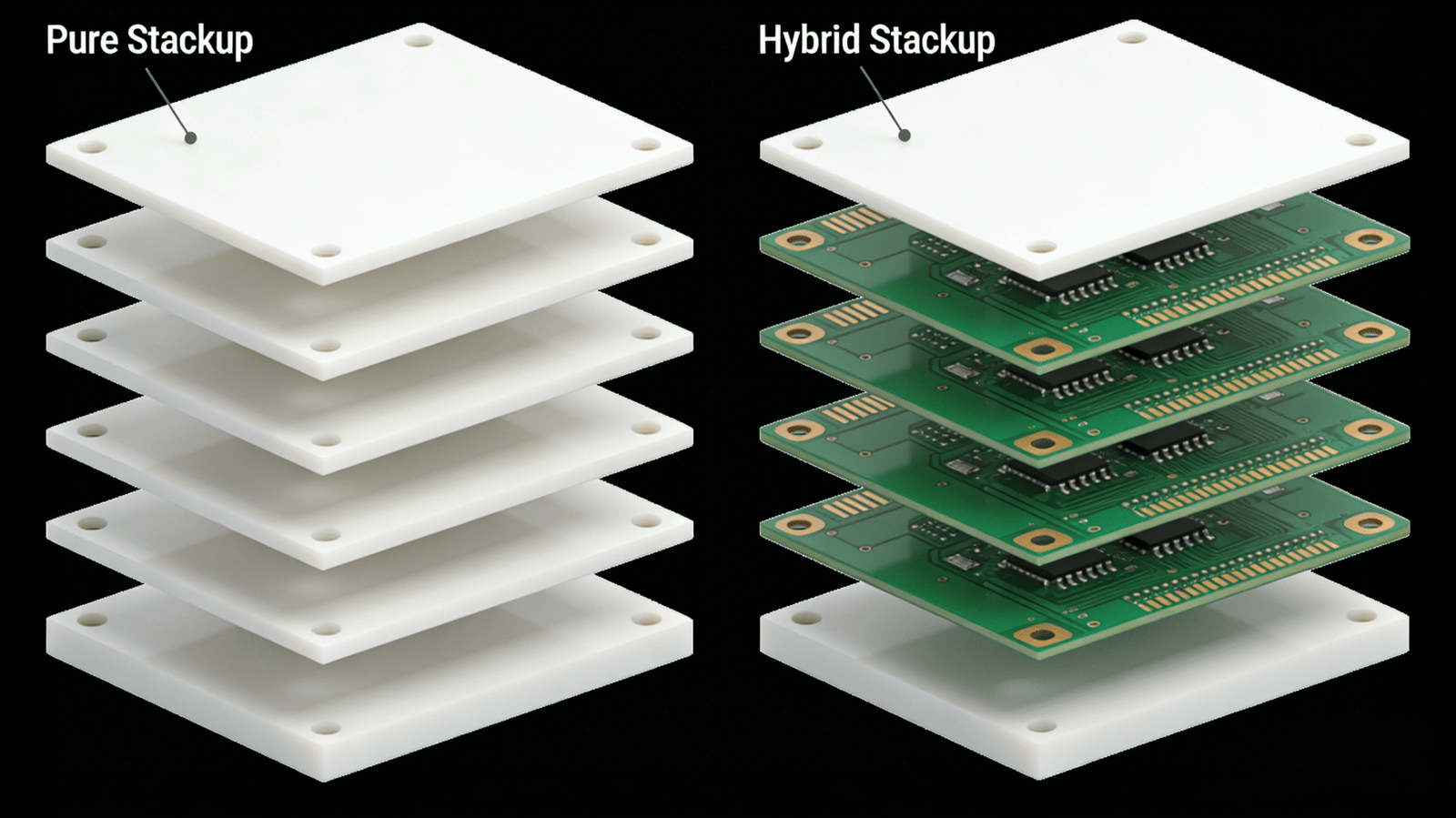
In a “Pure-Pressing” structure, every single layer of the multi-layer printed circuit board is fabricated using high-frequency materials. If it is an 8-layer board, all 8 layers, including the pre-preg bonding materials, are Rogers.
The Advantages: This approach delivers the absolute zenith of electrical performance. It guarantees uniform signal transmission across all internal and external layers, making it ideal for the most demanding RF Microwave PCB designs, such as military phased-array radars or ultra-high-speed satellite communication links.
The Challenges: The primary drawback is cost. High-frequency substrates are significantly more expensive than standard epoxy glass. Furthermore, pure PTFE-based materials are notoriously soft, which makes achieving perfect registration during multi-layer pressing and through-hole plating a significant manufacturing challenge, demanding top-tier equipment.
3. The Hybrid PCB Stackup: The Holy Grail of Cost-Efficiency
To solve the cost-to-performance dilemma, the industry developed the Hybrid PCB Stackup (mixed-pressing). In this configuration, we strategically combine high-frequency laminates (like Rogers or Taconic) with standard FR-4 materials within the same board.
In typical High-Frequency PCB Design, only the critical RF signal traces (usually on the outer layers, L1 and L2) require the low-loss properties of Rogers. The internal layers—which handle digital routing, power planes, and ground—can safely utilize cost-effective FR-4.
This intelligent material blending slashes raw material costs by up to 50% while maintaining 100% of the required antenna or RF performance. Additionally, the rigid FR-4 layers provide excellent mechanical stability to the overall board, making assembly easier.
4. Overcoming Hybrid Manufacturing Challenges
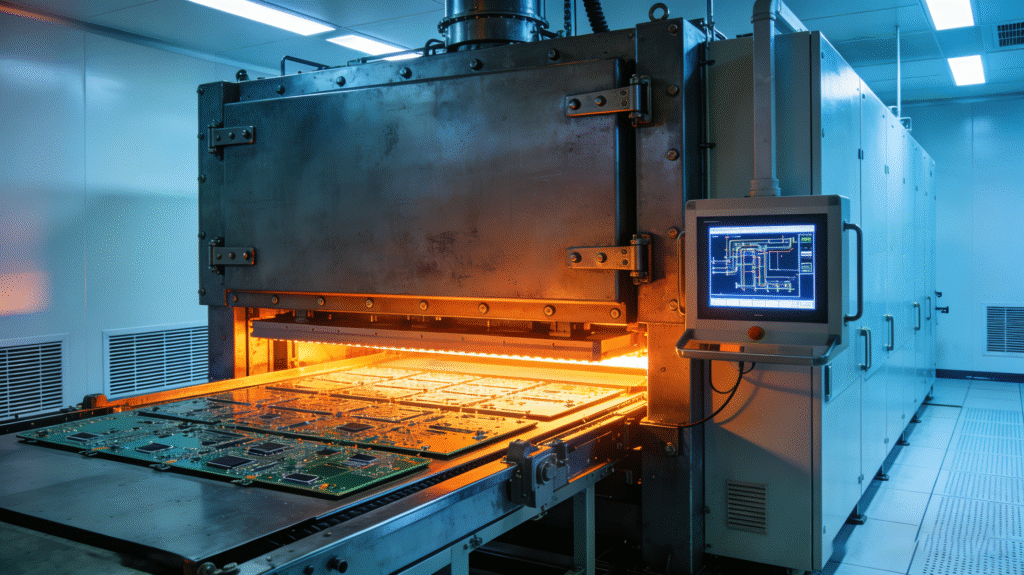
While the hybrid approach is highly economical, it introduces a massive fabrication challenge: CTE Mismatch. The Coefficient of Thermal Expansion (CTE) dictates how a material expands when heated. Rogers materials and FR-4 expand at completely different rates during the high heat of lamination pressing and SMT reflow soldering.
If handled by an inexperienced manufacturer, this mismatch inevitably leads to severe board warping, layer delamination, and fractured plated through-holes (PTH). Successfully pressing a mixed structure requires highly precise, customized temperature and pressure profiling.
5. Why Yichao is Your Premier RF PCB Partner
At Yichao Quick Technology, we have perfected the art of complex material processing. With over a decade of technical accumulation, we provide high-quality, customized solutions for both pure and mixed-pressing architectures. Our material warehouse is fully stocked with Rogers (Arlon), Taconic, Taizhou Wangling, and Shengyi series, eliminating supply chain delays.
Our manufacturing advantages directly address the challenges of RF boards:
- Precision Drilling: We utilize internationally advanced DaZu six-axis drilling machines to ensure perfect via registration, even across materials with varying densities.
- Advanced Stackups: We support up to 64 layers and seamlessly integrate high-frequency materials with HDI blind and buried via structures, thick copper, and metal edging.
- Strict Quality Control: Our ISO9001:2015 and IATF16949 certified digital smart factory employs LDI exposure, X-RAY, and AOI testing, guaranteeing a 99.8% product pass rate.
Conclusion
Selecting between a pure Rogers stackup and a hybrid structure is one of the most impactful decisions in your product development cycle. By leveraging a hybrid approach, you can achieve remarkable cost optimization without sacrificing signal integrity. However, this strategy relies heavily on the capability of your manufacturing partner. With Yichao’s intelligent manufacturing platform and fast-delivery model, your advanced high-frequency designs are in expert hands.