
A multi-layer printed circuit board is an engineering marvel, effectively functioning as a high-tech composite sandwich. However, over my decade-plus of experience overseeing complex fabrication projects, I have learned that the weakest link in any composite material is the adhesive boundary. When a B2B client comes to me with a field failure, the root cause often traces back to a microscopic war waged inside the board: the violent interaction between extreme heat and incompatible materials.
Understanding how Thermal Stress in PCB substrates physically destroys the chemical and mechanical bonds between layers is critical for any hardware engineer. Today, we are bypassing the surface-level symptoms and diving deep into the microscopic physics of layer separation, exploring why bonds break and how elite manufacturing processes prevent it.
1. The Anatomy of Interfacial Adhesion
To comprehend why a board falls apart, we must first understand what holds it together. The bond between the smooth copper foil and the fiberglass-reinforced epoxy resin (pre-preg) is not naturally strong. Manufacturers must engineer this adhesion through a combination of chemical bonding and mechanical interlocking.
During fabrication, the inner copper layers undergo a “brown oxide” or “black oxide” surface treatment. This chemical bath creates a microscopic, sponge-like roughness on the copper surface. When the board is subjected to high heat and pressure during the lamination cycle, the liquid resin flows into these microscopic peaks and valleys, curing into a solid mechanical anchor. If this oxide treatment is inconsistent, or if moisture compromises the resin before pressing, the baseline bond strength is fatally flawed from day one, setting the stage for devastating PCB Delamination later in the product’s lifecycle.
2. The Physics of Shear Stress: CTE Mismatch
Even with a perfect initial bond, the board must survive the laws of thermodynamics. Different materials expand at different rates when heated. This physical property is known as the Coefficient of Thermal Expansion PCB (CTE).
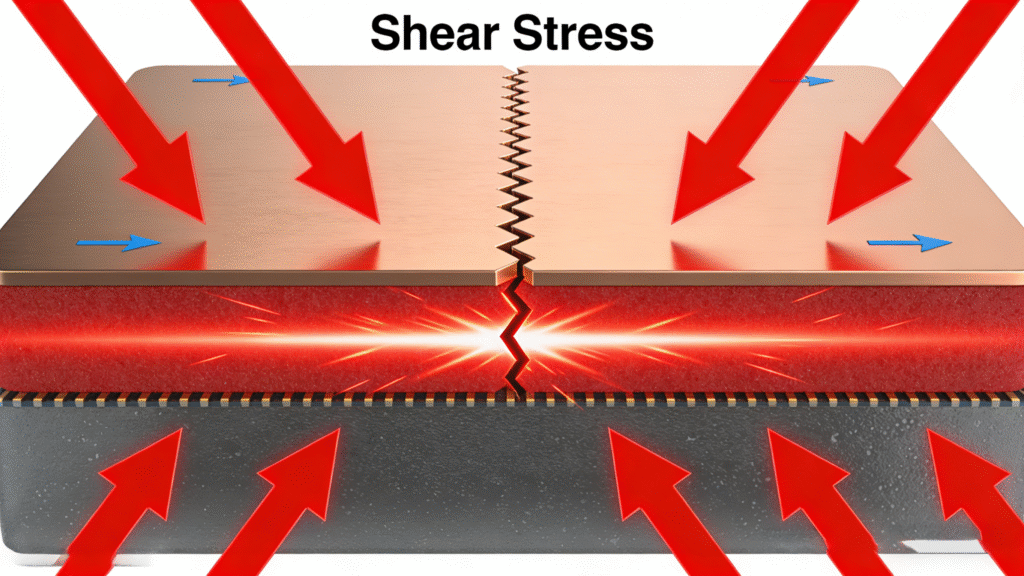
Copper has a relatively low and predictable CTE. FR4 epoxy resin, however, expands at a vastly different, non-linear rate, especially once it surpasses its Glass Transition Temperature (Tg). When the board is subjected to rapid heating, the resin attempts to expand outward and upward much faster than the copper traces it is anchored to.
This differential expansion creates immense “shear stress” directly at the copper-resin interface. Imagine two sheets of sandpaper glued together, with two powerful machines trying to slide them in opposite directions. If the shear force generated by the CTE mismatch exceeds the peel strength of the oxide-treated bond, the layers violently rupture. This internal tearing severs blind vias, destroys high-frequency signal integrity, and creates microscopic voids that trap moisture.
3. The Crucible: Lead-Free Solder Temperature
When does this catastrophic thermal stress actually occur? The most dangerous environment a circuit board will ever face is not in the field, but on the assembly line. The transition to RoHS-compliant manufacturing introduced a massive thermal hurdle: extreme Lead-Free Solder Temperature.
Traditional leaded solder reflowed at around 210°C. Modern lead-free alloys (like SAC305) require the Surface Mount Technology (SMT) reflow oven to peak between 245°C and 260°C. At these extreme temperatures, the moisture trapped inside the microscopic voids of the resin rapidly vaporizes into high-pressure steam. This steam pressure, combined with the extreme CTE shear stress, acts like an internal explosive charge, popping the layers apart.
4. Advanced PCB Failure Analysis: Identifying the Rupture
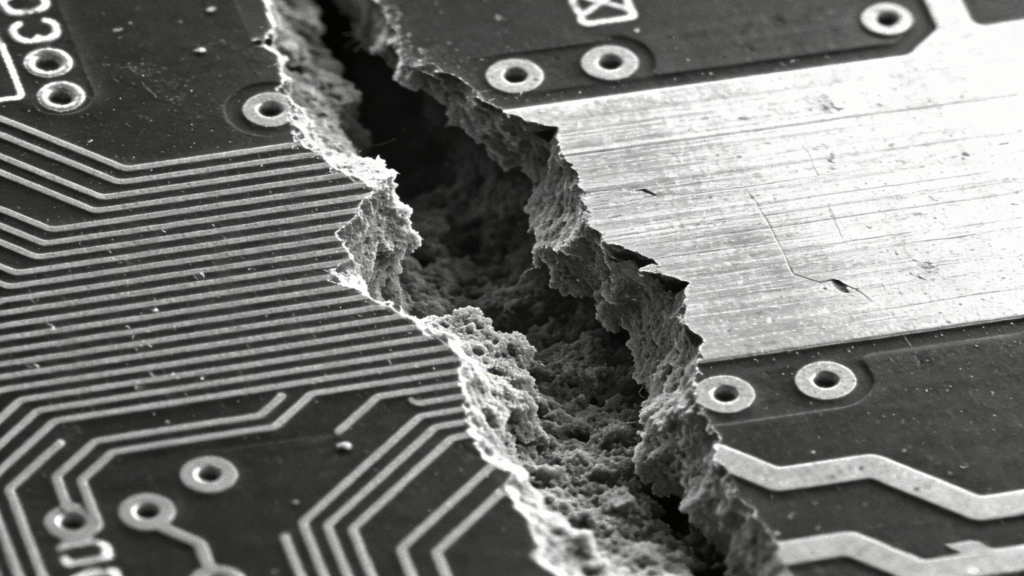
When a B2B client experiences intermittent open circuits, we utilize advanced PCB Failure Analysis to identify the exact nature of the bond failure. By cross-sectioning the board and examining it under a Scanning Electron Microscope (SEM), we categorize the rupture:
- Adhesive Failure: The separation occurs cleanly between the copper and the resin. This usually indicates a failure in the factory’s brown oxide surface preparation process.
- Cohesive Failure: The separation occurs entirely within the resin itself, leaving resin stuck to both sides of the tear. This indicates that the bond was strong, but the extreme thermal stress or trapped moisture simply overwhelmed the tensile strength of the substrate material.
5. Engineering the Solution with Yichao Quick Technology
Preventing interfacial failure requires a manufacturing partner who controls the thermal and chemical environment with absolute authority. Since 2013, Yichao has built a digital smart factory designed to engineer out the risk of delamination, offering High-Reliability Circuit Board Assembly for the AI, medical, and automotive sectors.
Our defense against thermal stress is multi-layered. First, we strictly control the moisture content of our premium pre-pregs (from suppliers like Rogers, Shengyi, and Taconic) in climate-controlled storage and utilize rigorous pre-baking cycles before lamination. During inner-layer processing, our automated chemical lines ensure perfect, uniform oxide treatments to maximize mechanical interlocking.
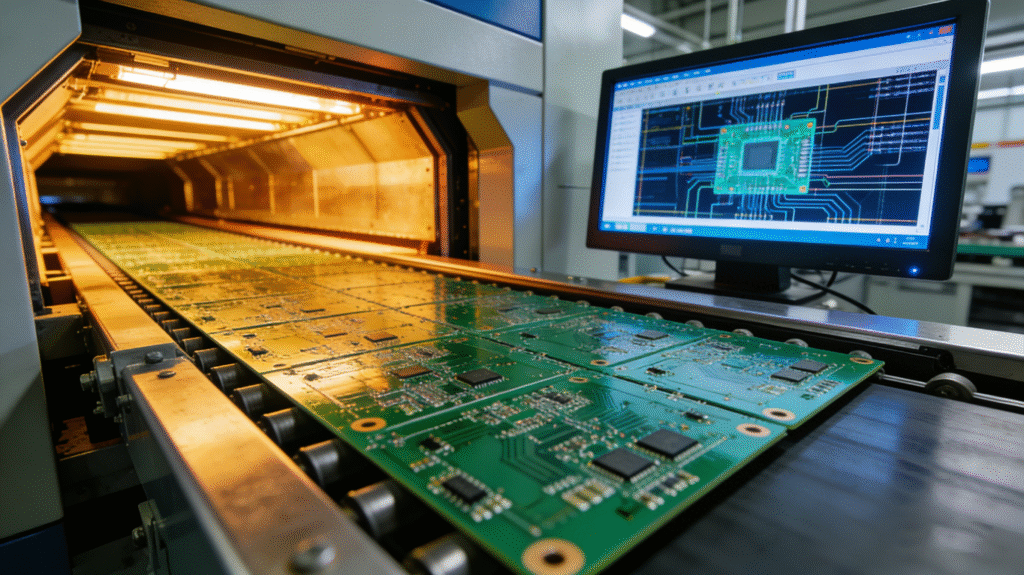
Finally, we protect the board during assembly. Our facility boasts 4 sets of highly advanced 10-temperature zone reflow soldering machines. These multi-zone ovens allow our engineers to create incredibly precise thermal profiles. By gradually ramping up the heat, we minimize thermal shock and safely evacuate any residual outgassing before hitting the peak lead-free temperatures. Combined with strict X-RAY and AOI testing, our ISO9001:2015 and IATF16949 certified processes ensure your boards survive the oven and excel in the field.
Conclusion
The bond between layers is the literal foundation of your product’s reliability. By understanding the destructive forces of CTE mismatch and extreme reflow temperatures, B2B buyers can make informed decisions about material selection and factory capabilities. Don’t let invisible thermal stress dictate your failure rate—partner with a manufacturer capable of engineering unbreakable bonds.